
What Does AI Agent Development Cost in 2026? A Business Guide
Explore AI agent development costs in 2026, what drives budget, when to build a prototype, and how to choose the right AI software partner.

Introduction
AI agents are moving quickly from “interesting experiment” to practical business tool. But for many companies, the biggest question is not whether AI can help. It is whether the investment makes sense.
A simple AI assistant can be built relatively quickly. A production-ready AI agent that connects to business systems, uses company data securely, performs actions, handles exceptions and supports real users is a very different project.
That is why the cost of AI agent development in 2026 depends less on the word “AI” and more on the business workflow behind it.
Are you building a prototype to validate an idea? An internal automation tool? A customer-facing assistant? A multi-step agent that interacts with CRMs, ERPs, support platforms, APIs or cloud systems?
Each scenario has a different level of complexity, risk and budget.
This guide explains what usually drives the cost of building an AI agent, how to plan your budget, and when it makes sense to work with an AI custom software development partner.
What is AI agent development?
AI Agent development is the process of designing, building and deploying software systems that can use AI to understand context, make decisions and perform actions.
Unlike a basic chatbot, an AI agent can usually do more than answer questions. It may retrieve information, trigger workflows, connect to tools, update records, classify requests, generate documents, monitor data or guide users through complex processes.
In a business context, common AI agent use cases include:
- Customer support automation
- Sales qualification and lead routing
- Internal knowledge assistants
- Operations workflow automation
- Document processing and summarisation
- Data analysis and reporting assistants
- SaaS product features powered by AI
- AI copilots for teams or customers
The development cost depends on how much autonomy the agent needs, which systems it must connect to and how reliable it must be before going live.
How much does AI agent development cost in 2026?
As a practical planning range, many AI agent projects fall into three broad categories.
1. AI agent prototype or proof of concept
A prototype is designed to test whether the idea works. It may use a limited data source, a small set of prompts, basic integrations and a controlled group of users.
Typical budget range: €6,000 to €15,000
This can be enough for companies that want to validate a use case before committing to a full build. For example, an operations team may want to test whether an AI agent can classify inbound requests and suggest next steps.
A prototype should answer one question: is this workflow worth productising?
2. Production-ready AI workflow or business agent
A production-ready agent needs stronger architecture. It must be secure, reliable, maintainable and integrated with real systems. It also needs testing, monitoring, error handling and clear rules for human escalation.
Typical budget range: €15,000 to €60,000
This is the most common range for companies that already know the business problem and want to build something usable by internal teams or selected customers.
Examples include an AI assistant connected to a knowledge base, an automated document review workflow, or an agent that helps support teams resolve tickets faster.
3. Complex AI platform or multi-agent system
More advanced projects involve multiple workflows, several integrations, custom interfaces, role-based access, analytics, audit logs, cloud infrastructure, compliance requirements and ongoing optimisation.
Typical budget range: €60,000 to €120,000+
These projects are closer to custom software platforms than simple AI tools. The AI component is only one part of the system. The real work often sits in architecture, data, security, integration and long-term scalability.
What drives the cost of an AI agent?
Workflow complexity
A simple question-answer assistant is cheaper than an agent that must follow a multi-step business process.
For example, “answer questions from a knowledge base” is relatively contained. “Analyse a customer request, check account data, create a ticket, assign priority and update a CRM” requires more logic, testing and safeguards.
Data readiness
Many AI projects slow down because company data is not ready.
If documents are scattered, outdated or inconsistent, the project may need extra work before the AI agent can use them reliably. This can include cleaning, structuring, indexing or connecting data sources.
Integrations
AI agents become valuable when they connect to real business systems. But every integration adds complexity.
CRM, ERP, ticketing tools, payment systems, internal databases, cloud storage and third-party APIs all need secure connection, authentication, permissions and error handling.
User interface
Some agents only need to work inside an existing platform. Others require a custom web app, dashboard or SaaS interface.
If the agent is part of a customer-facing product, the interface must be designed with usability, performance and trust in mind.
Security and compliance
For European companies, security and data governance are not optional. The agent may need access controls, audit logs, data retention rules, GDPR-aware architecture and clear separation between sensitive and non-sensitive data.
This is one of the main reasons why business AI projects should not be treated as quick experiments once they touch real users or real company data.
Model usage and operating costs
The development budget is only part of the total cost. AI agents also have running costs.
These may include model usage, vector databases, cloud infrastructure, monitoring tools, external APIs and maintenance. A good technical partner should help you estimate both build cost and ongoing operating cost before development starts.
Prototype or production system: which should you build first?
Not every company should start with a full production AI agent.
If the use case is new, a prototype is usually the safest first step. It helps validate whether the workflow is valuable, whether the data is good enough and whether users actually trust the output.
A production system makes sense when:
- The business workflow is clear
- The expected value is measurable
- The agent needs to connect to operational systems
- Real users will depend on it
- Security and reliability matter
- The company wants to scale the workflow over time
The mistake is not starting small. The mistake is building a prototype with no path to production.
A quick demo can be useful, but if it is not designed with architecture, security and maintainability in mind, it may need to be rebuilt later.
Common mistakes that increase AI agent development cost
Many AI agent projects become more expensive because the scope is unclear at the beginning.
The most common mistakes include:
- Trying to automate too many workflows at once
- Starting with the technology instead of the business problem
- Using poor or unstructured data
- Underestimating integrations
- Ignoring human review and escalation
- Treating compliance as a final step
- Building a demo that cannot scale
- Choosing tools before defining the operating model
A better approach is to define the business outcome first. What should the agent improve? Speed? Accuracy? Cost? Customer experience? Team productivity? Decision-making?
Once that is clear, the technical architecture becomes much easier to plan.
How to choose the right AI development partner
Choosing an AI development partner is not only about finding someone who can build prompts or connect to an API.
For business AI projects, you need a team that understands software architecture, cloud systems, security, integrations, UX and long-term maintainability.
A strong partner should help you answer questions such as:
- What should be automated and what should stay human-led?
- Which parts of the workflow need AI and which do not?
- What data does the agent need?
- Which systems must it connect to?
- How will quality be measured?
- What happens when the agent is unsure?
- How will the system be monitored after launch?
- What will it cost to run at scale?
This is where AI custom software development becomes important. The agent is not isolated. It must fit into your business processes, product architecture and existing technology stack.
How Unimedia helps companies build AI agents
Unimedia Technology helps companies design, build and scale agentic AI workflows, automation systems and AI-powered software products.
That can mean starting with a fast proof of concept, turning an existing n8n, Make or custom workflow into a secure production system, or developing a complete AI platform that integrates with your business tools.
For companies that already have an AI prototype, Unimedia can also help assess whether it is ready for production, secure enough to scale and maintainable for long-term use.
If your AI agent needs to connect with cloud infrastructure, SaaS platforms or custom business software, it is important to approach the project as a software engineering challenge, not just an AI experiment.
A well-built AI agent should be useful, secure, measurable and aligned with the way your company actually works.
Conclusion: plan your AI agent as a business investment
The cost of AI agent development in 2026 depends on scope, data, integrations, security and production readiness.
A small prototype may be enough to validate a use case. A production-ready AI agent requires stronger architecture, testing, monitoring and long-term support. A complex AI platform needs the same discipline as any serious custom software project.
The best starting point is not asking, “How much does an AI agent cost?”
A better question is: “Which business workflow is valuable enough to automate, and what level of reliability does it need?”
Once that is clear, the budget becomes much easier to define.
FAQs
How much does it cost to build an AI agent?
A simple AI agent prototype may start around €8,000 to €25,000. A production-ready AI agent often ranges from €25,000 to €80,000, while complex AI platforms or multi-agent systems can exceed €80,000 depending on integrations, data, security and scale.
What is the difference between an AI chatbot and an AI agent?
A chatbot usually answers questions. An AI agent can understand context, use tools, connect to systems and perform actions within a defined workflow.
Is it better to start with an AI prototype?
Yes, if the use case is still uncertain. A prototype helps validate value before investing in a full production system.
What makes AI agent development expensive?
The main cost drivers are workflow complexity, data readiness, integrations, user interface, security, compliance, testing and ongoing model usage.
Can an existing automation workflow become an AI agent?
Yes. Existing workflows built with tools such as n8n, Make or custom scripts can often be productised into more secure, scalable AI-powered systems.
Want this costed for your own case?
We will write down what we think you are asking for before we put a number on it, so the assumptions are visible while they are still cheap to argue with.
Keep reading
More on Artificial Intelligence (AI)
How to Build a Booking Platform with AI (Real Business Case)
Booking platform development with AI-supported delivery. Get an estimate from Unimedia and turn your idea into a scalable SaaS product.
Artificial Intelligence (AI)

AI in SaaS: Practical Use Cases That Drive Business Growth
AI in SaaS can boost growth with automation, personalization, and smarter workflows. Request a demo with Unimedia.
Artificial Intelligence (AI)
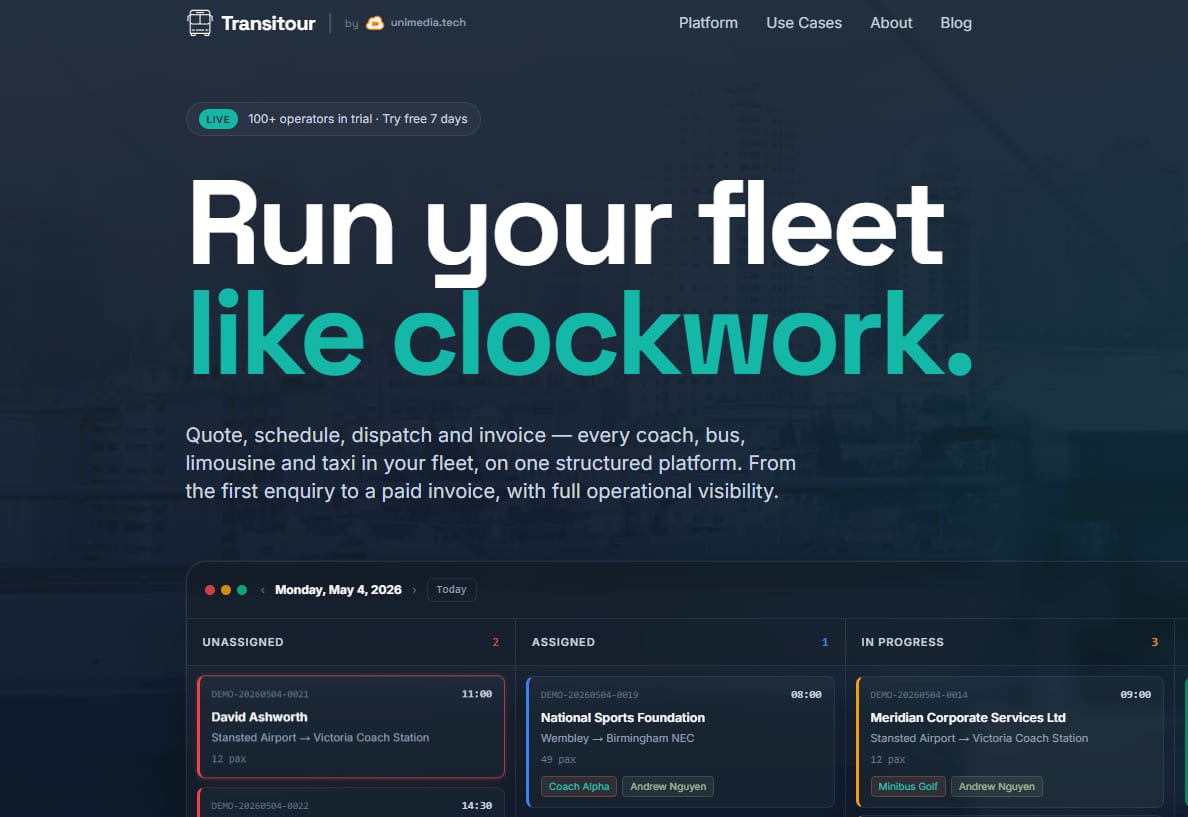
How We Used AI to Build a SaaS Platform for Transport Companies
SaaS with AI case study: see how Unimedia used AI-assisted development to build Transitour faster. Book a call with our team.
Artificial Intelligence (AI)