
AI Custom Software Development: From Prototype to Production
Turn your AI prototype into business-ready software. Discover how custom AI development connects models, data, workflows and secure production systems.
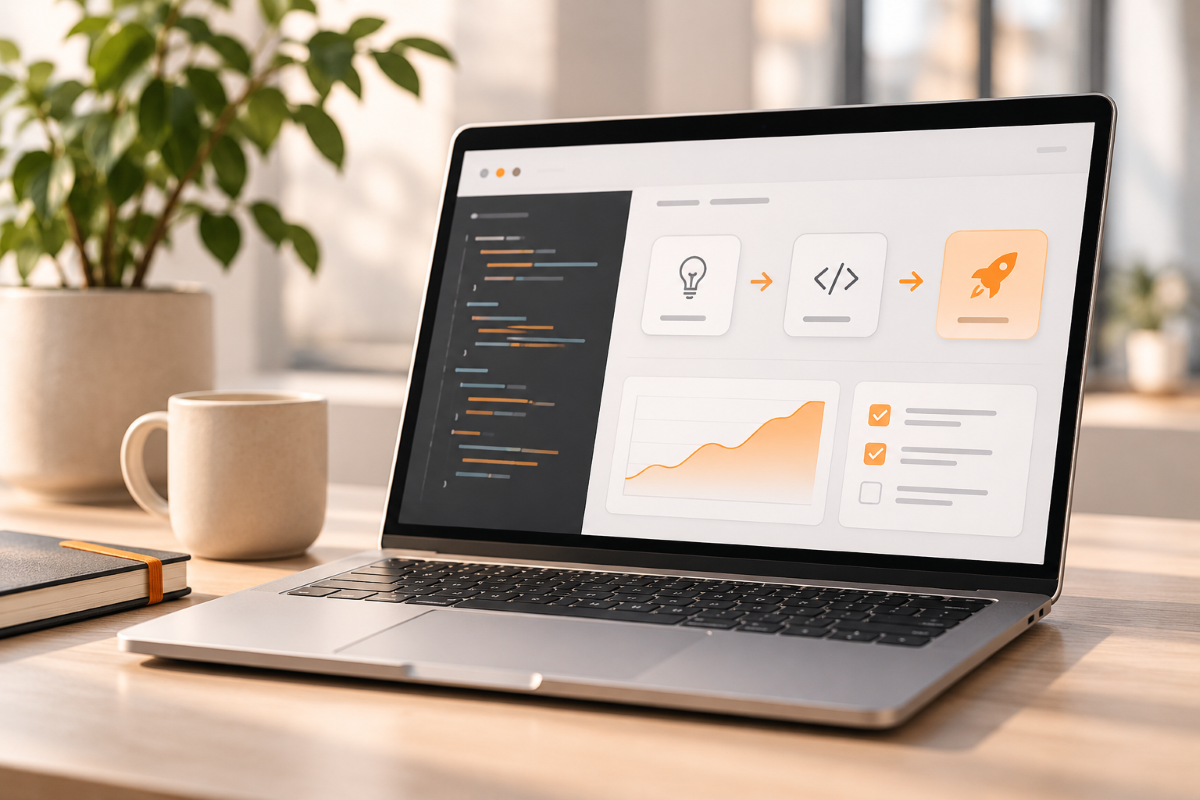
AI custom software development is becoming a practical investment for companies that want to integrate artificial intelligence into their products and operations. Many businesses already have a working prototype. The challenge is turning that early success into reliable software that employees and customers can use every day.
A prototype might answer questions, process documents or automate a simple task. But once it needs to connect with customer databases, financial systems or internal workflows, the requirements change.
Companies need secure integrations, predictable performance, measurable accuracy and a system their engineering team can maintain.
In this article, we explain what custom AI development involves, how to approach the transition from prototype to production and what to look for when choosing an AI software development company.
What Is AI Custom Software Development?
AI custom software development is the process of designing and building applications that use artificial intelligence to solve specific business problems.
Instead of relying entirely on a ready-made AI tool, companies can develop software that works with their existing data, processes and technology infrastructure.
Examples include:
- AI assistants connected to internal company knowledge.
- Document processing systems that extract information from invoices, contracts or reports.
- Customer service applications that retrieve account information and support agents.
- AI-powered features integrated into existing SaaS products.
- Automated workflows connecting CRM, ERP and other business platforms.
- Intelligent reporting tools that help teams analyse operational information.
These applications typically combine AI models with traditional software components such as databases, APIs, authentication, business rules and user interfaces.
This is why a successful AI project requires expertise in both artificial intelligence and software engineering.
Why AI Prototypes Often Struggle in Production
Building a convincing AI demonstration has become easier. Modern models, APIs and development tools allow teams to test ideas without investing immediately in a complete software platform.
However, a prototype usually operates in a controlled environment. It may use a limited dataset, have only a few users and depend on manual supervision.
Real business environments introduce additional requirements.
Integration with existing systems
An AI application becomes more useful when it can access relevant business information.
For example, an AI assistant used by a customer service team may need to retrieve customer records, check order status and create support tickets.
That requires secure integrations with existing applications, appropriate permissions and reliable data exchange.
An experienced AI development partner can help design these integrations around the company's existing infrastructure.
Accuracy and predictable behaviour
AI-generated responses are not always correct. This becomes a business risk when applications process financial information, communicate with customers or support operational decisions.
Production systems need evaluation datasets, output validation and clear procedures for handling uncertain results.
For higher-risk actions, human approval may be necessary before the software updates records, sends information or executes a transaction.
Security and data protection
Business AI applications may process confidential information, customer data and internal documents.
Companies must understand what information is sent to external models, where it is processed, who can access it and how long it is retained.
Security controls should cover authentication, authorisation, encryption, audit logs and protection against malicious or unexpected model inputs.
The OWASP Top 10 for LLM Applications provides a useful reference for risks such as prompt injection, sensitive information disclosure and excessive permissions.
Performance and operating costs
An application that works well for ten users may behave differently when hundreds of people use it simultaneously.
Response times, model usage, cloud resources and external API calls all affect the operating cost.
Companies should therefore evaluate cost per request, expected usage, latency and infrastructure requirements before scaling.
How to Take Custom AI Software from Prototype to Production
Moving an AI application into production works best as a structured engineering project with clear business objectives.
1. Define the business outcome
Start with the problem the software must solve.
Will it reduce the time spent processing documents? Improve the speed of customer support? Help employees retrieve information? Introduce a new feature into an existing product?
The expected outcome should be measurable.
For example, if an AI application processes incoming customer requests, useful metrics might include processing time, classification accuracy and the percentage of cases requiring manual review.
These measures make it possible to evaluate whether the investment is delivering value.
2. Assess the existing prototype
Companies do not necessarily need to rebuild their AI application from scratch.
A technical assessment can determine which parts of the existing solution are reusable and which need further development.
The review should cover:
- Application architecture and code quality.
- Data sources and integrations.
- Model selection and dependencies.
- Authentication and user permissions.
- Error handling and fallback procedures.
- Testing, monitoring and deployment processes.
The result should be a practical development roadmap, prioritised according to business risk and expected value.
3. Design the production architecture
Once the requirements are clear, the development team can define how the AI functionality will operate within the wider application.
This may involve a frontend, backend services, databases, model APIs, retrieval systems and cloud infrastructure.
A well-designed architecture separates business logic from model-specific functionality. This makes it easier to change providers or introduce new models when requirements evolve.
It also allows the business to add users, workflows and integrations without redesigning the entire application.
4. Connect AI to business workflows
AI applications create more value when their outputs become part of an existing process.
Consider a company receiving hundreds of documents from customers every week.
An AI-powered workflow might:
- Receive a document through a customer portal.
- Extract relevant information.
- Validate the extracted fields against business rules.
- Flag incomplete or uncertain records for review.
- Send approved information to the company's ERP or database.
- Record the result for auditing and reporting.
The AI model performs part of the work, while the surrounding software handles validation, permissions, integrations and operational control.
This type of solution can be developed through custom AI development services tailored to the company's workflow.
5. Test with realistic business data
Testing an AI application requires more than checking whether the code runs correctly.
The team must also evaluate how the model behaves with realistic inputs, incomplete information and unexpected situations.
A practical testing strategy should include:
- Representative datasets based on actual business scenarios.
- Accuracy and quality thresholds.
- Tests for unusual or ambiguous inputs.
- Security and access-control testing.
- Performance and load testing.
- Validation of integrations and error recovery.
Evaluation results should be recorded so the team can compare performance after changing models, prompts or application logic.
6. Deploy, monitor and improve
Launching an AI application is the beginning of its operational lifecycle.
Teams need visibility into model performance, application errors, response times and usage costs.
Monitoring also helps identify changes in output quality as business data, user behaviour or model versions evolve.
Regular evaluations and controlled updates help maintain the system as requirements change.
Build, Buy or Customise: Which Approach Makes Sense?
Not every AI requirement justifies building custom software.
Businesses should consider the complexity of the workflow, the sensitivity of their data and the level of integration required.
When an existing AI tool is enough
A ready-made application may be the best choice when the task is relatively standard and does not require extensive customisation.
Examples include general writing assistance, basic meeting summaries or common productivity tasks.
Buying an existing solution can reduce initial implementation work and allow teams to validate business value quickly.
When custom AI development makes sense
Custom development becomes more attractive when:
- The AI must integrate with several internal systems.
- The workflow includes business-specific rules or approvals.
- The application processes sensitive or proprietary information.
- AI functionality is part of a commercial software product.
- The company needs control over architecture, integrations and future development.
- Existing tools cannot meet operational or security requirements.
In many projects, the most efficient approach is a combination of existing AI models and custom software engineering.
The business benefits from proven model capabilities while retaining control over its application logic and integrations.
What Determines the Cost of Custom AI Software Development?
The development budget depends on the requirements of the application rather than the AI model alone.
Several factors have a significant impact.
Data preparation
Business information may need cleaning, restructuring or indexing before the AI application can use it effectively.
System integrations
Connecting an AI application to CRM, ERP, payment or internal systems requires development, authentication, testing and ongoing maintenance.
Application complexity
A document classification tool has different requirements from a multi-step AI workflow that performs actions across several business systems.
Security and compliance
Data protection requirements, access controls, auditability and sector-specific obligations can affect architecture and implementation effort.
Operational infrastructure
AI applications may generate recurring costs from model usage, cloud hosting, databases, monitoring and third-party APIs.
The budget should include both initial development and ongoing operations.
Companies planning an investment should request a technical assessment that identifies the scope, main dependencies and cost drivers before committing to full development.
How to Choose an AI Software Development Company
Choosing an AI software development company involves more than comparing experience with particular models or frameworks.
The right partner should understand how the application fits into the company's technology infrastructure and business processes.
Before selecting a provider, ask:
- Can the team deliver the complete application, including backend, frontend and integrations?
- How will AI output quality be evaluated?
- What safeguards will protect company and customer data?
- Can the solution work with existing cloud infrastructure?
- How will usage costs and application performance be monitored?
- Who owns the code, infrastructure and intellectual property?
- What happens when the application needs new features or additional capacity?
A strong development partner should also challenge unnecessary complexity.
Some tasks are better handled by conventional software, predefined rules or existing tools. Identifying those cases early can reduce implementation costs and simplify maintenance.
How Unimedia Helps Businesses Develop Custom AI Software
Unimedia Technology works with companies that want to design, build and integrate AI-powered applications into real business environments.
Our approach combines AI development with software architecture, cloud engineering and integration expertise.
Depending on the project, we can help businesses:
- Assess an existing AI prototype and identify the next development steps.
- Design AI-powered features for SaaS and business applications.
- Build intelligent workflows and agents connected to company systems.
- Integrate AI capabilities into existing software products.
- Implement evaluations, safeguards and monitoring.
- Prepare applications for deployment and ongoing development.
Our senior engineering team is based in Europe, near Barcelona, and works with international clients.
We focus on practical solutions that fit each company's requirements, technology stack and long-term objectives.
Explore our AI software development services to see how we can support your project.
Conclusion: Build AI Software Around Real Business Needs
AI custom software development offers companies a way to turn promising experiments into applications that support real operations.
The most important decisions concern business value, architecture, data, integrations, reliability and long-term maintainability.
A successful project begins with a clear understanding of what the application must achieve and how its performance will be measured.
If your company has an AI prototype, an automation idea or a product that could benefit from custom AI functionality, Unimedia can help you evaluate the next steps.
Book an AI Strategy Call to discuss your requirements and identify a practical development approach.
Frequently Asked Questions
What is AI custom software development?
AI custom software development involves building applications that combine artificial intelligence with business-specific functionality, data and integrations. These solutions are designed around the requirements of a particular organisation rather than a standard software product.
Can an existing AI prototype be converted into production software?
Yes. Many prototypes can be extended into production applications. The first step is to assess the existing architecture, integrations, security and code quality to determine what can be reused and what needs improvement.
How much does custom AI software development cost?
The cost depends on scope, integrations, data preparation, application complexity, security and infrastructure. A technical assessment helps establish a realistic budget for development and ongoing operations.
Do companies need to train their own AI models?
Not necessarily. Many business applications use existing AI models through APIs and combine them with custom software, company data and business rules. Training or fine-tuning a model is useful only when the project's requirements justify it.
How long does it take to develop a custom AI application?
Timelines vary according to the project's scope and technical requirements. A limited proof of concept can be developed relatively quickly, while a complete business application with multiple integrations, security controls and production infrastructure requires more extensive engineering.
What should businesses look for in an AI development partner?
Look for experience in AI integration, software architecture, cloud infrastructure, security, testing and ongoing support. The provider should explain how it will measure output quality, control operating costs and maintain the application after launch.
Thinking about putting AI into your own product?
We take AI features from a convincing demo to something you can charge for: evaluated, observable and with the cost per action under control.
Keep reading
More on Artificial Intelligence
Software Architecture Consulting: When Your Product Has Outgrown Its Architecture
Your software worked well when it launched. Now every new feature takes longer, performance suffers and technical debt keeps growing. Discover when an architecture review can help your product scale.
Software Development

Custom Headless CMS Development: When Does It Make Sense?
Headless CMS can offer much more flexibility, but not every business needs it. Find out when a custom headless architecture is worth considering.
Web Development
Customer Portal Development: When Should You Build Instead of Buy?
An off-the-shelf portal can be the right choice—until your workflows, integrations and permissions start working around the software instead of with it.
Software Development