
Software Architecture Consulting: When Your Product Has Outgrown Its Architecture
Your software worked well when it launched. Now every new feature takes longer, performance suffers and technical debt keeps growing. Discover when an architecture review can help your product scale.
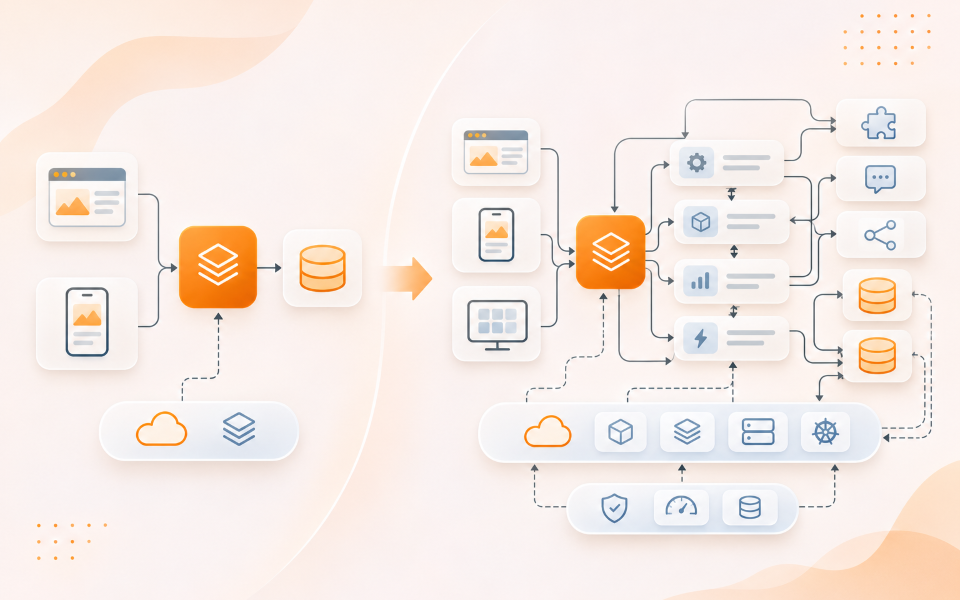
Your software product is growing. You have more users, more features, more integrations and a larger development team. But something has changed: delivering new functionality takes longer, performance issues are harder to resolve, and even small updates can introduce unexpected problems.
The architecture that supported your product's early success may now be limiting its growth.
This is a common challenge for established software products and growing SaaS platforms. Decisions that made sense when the application had a few hundred users may become difficult to maintain when it supports thousands of customers, complex integrations or critical business operations.
Software architecture consulting helps companies understand these limitations, identify technical risks and decide which improvements will deliver the greatest business value.
And importantly, improving an architecture does not necessarily mean rebuilding the entire product.
What Does It Mean to Outgrow Your Software Architecture?
Every software product is built around a set of technical decisions: how data is stored, how services communicate, how infrastructure is managed and how different parts of the application work together.
Those decisions reflect the product's original requirements, budget, team and expected scale.
For an early-stage startup, a relatively simple monolithic application might be the right choice. It allows a small team to develop features quickly, maintain a manageable codebase and bring the product to market without unnecessary complexity.
As the business grows, however, new requirements emerge:
- More users and higher transaction volumes.
- More sophisticated business logic.
- Additional integrations with external platforms.
- New security and compliance requirements.
- Larger engineering teams working on the same codebase.
- Greater expectations for availability and performance.
The original architecture may struggle to accommodate these changes efficiently.
This does not mean the original technical decisions were wrong. They may have been entirely appropriate for the product's earlier stage.
The challenge is determining which parts of the architecture need to evolve and which can continue working as they are.
7 Signs Your Software Architecture Is Holding Your Product Back
Architecture problems rarely appear as a single dramatic failure. More often, they develop gradually, affecting delivery speed, operational costs and the engineering team's ability to improve the product.
Here are seven warning signs worth investigating.
1. New Features Take Increasingly Longer to Deliver
A feature that once required a few days now takes several weeks. Developers need to modify multiple components, account for unexpected dependencies and spend additional time testing changes.
This often happens when different parts of the system have become tightly coupled.
For example, adding a new subscription model to a SaaS platform might require changes to billing, authentication, permissions, reporting and customer management.
If those components have unclear boundaries, even a relatively small business requirement can become a complex development project.
Software architecture services can help identify these dependencies and determine whether better separation of responsibilities would make future development easier.
2. Small Changes Create Unexpected Problems
Your team fixes one issue and another appears somewhere else.
Releases require extensive manual testing because developers cannot confidently predict which parts of the application will be affected by a change.
This can indicate architectural coupling, insufficient automated tests, unclear data ownership or components that handle too many responsibilities.
The consequences extend beyond engineering. Unpredictable releases can delay customer commitments, increase support requests and make product planning less reliable.
3. Performance Problems Appear as Usage Grows
An application that performed well with 500 users may behave differently with 20,000.
Slow database queries, inefficient API calls, overloaded services and resource contention can become increasingly visible as demand grows.
Adding more servers or increasing cloud capacity may temporarily improve performance, but it does not always address the underlying problem.
A software architecture assessment can help determine whether the bottleneck is caused by application design, database structure, infrastructure configuration or communication between components.
The goal is to understand what is limiting performance before investing in additional resources or major architectural changes.
4. Technical Debt Is Influencing Your Product Roadmap
Most software products accumulate technical debt.
Shortcuts are sometimes necessary to meet deadlines, validate an idea or respond to customer requirements. The problem arises when those decisions consistently prevent the team from moving forward.
You may notice that:
- Important improvements are repeatedly postponed.
- Developers spend substantial time maintaining older components.
- New features require increasingly complex workarounds.
- Critical knowledge is concentrated in one or two engineers.
- Product priorities are determined by technical limitations rather than customer needs.
At this stage, technical debt becomes a business concern.
An effective architecture review should distinguish between debt that can be safely managed and structural problems that justify investment.
5. Integrations Are Becoming Fragile
Growing software platforms rarely operate in isolation.
They exchange data with CRMs, payment providers, analytics tools, customer portals, external APIs and other business systems.
As integrations multiply, poorly defined interfaces can create operational problems: inconsistent data, duplicated logic, unexpected failures and difficult troubleshooting.
For example, if several services independently update customer information, maintaining consistency becomes increasingly complicated.
Custom solution architecture services can help review integration patterns, data ownership, API boundaries and failure handling.
Better integration architecture can make existing systems more reliable while preparing the product for future connections.
6. Infrastructure Complexity and Costs Keep Growing
Cloud infrastructure makes it possible to scale applications without managing physical servers. But a cloud deployment is not automatically efficient or scalable.
Over time, products may accumulate unnecessary services, oversized resources, duplicated environments or infrastructure decisions that no longer match their usage patterns.
Increasing cloud costs can be a symptom of inefficient application architecture, infrastructure configuration or resource management.
However, cost alone does not prove that the architecture needs redesigning.
A proper review should examine application workloads, infrastructure utilisation, scaling behaviour and operational requirements before recommending changes.
7. Adding Developers Does Not Improve Delivery Speed
Hiring more engineers should increase development capacity. But when the architecture is difficult to understand or modify, larger teams can create additional coordination problems.
Developers may frequently work on the same components, encounter conflicting changes or depend on a small number of senior engineers to approve modifications.
Onboarding also becomes slower when system boundaries are unclear and documentation is limited.
This is particularly relevant for scale-ups transitioning from a small founding team to multiple engineering teams.
At this stage, architecture decisions should support both the product's technical requirements and the organisation responsible for developing it.
Do You Need to Rewrite Your Application? Usually, Not Yet
When a software product becomes difficult to maintain, a complete rewrite can seem attractive.
Starting again offers the possibility of cleaner code, modern technologies and an architecture designed around current requirements.
But rebuilding an established product carries substantial risks.
The existing application may contain years of business logic, integrations, exceptions and operational knowledge that are not fully documented.
Reproducing all that functionality can take significantly longer than expected. Meanwhile, the current product still needs maintenance, customer support and new features.
In many situations, a more targeted approach is preferable.
Refactor Critical Components
Improve the internal structure of problematic modules without changing their intended behaviour.
This may reduce complexity, improve testability and make future changes easier.
Separate Highly Coupled Functionality
Identify components with excessive dependencies and introduce clearer boundaries.
This can often be achieved within an existing monolith. Moving everything to microservices is not automatically the right answer.
Improve Database and Data Access Patterns
Review slow queries, indexing strategies, data models and how different application components access information.
Sometimes the largest performance improvements come from targeted database changes rather than a complete architectural redesign.
Modernise Infrastructure Incrementally
Evaluate deployment processes, monitoring, resource allocation and cloud configuration.
Incremental changes may improve reliability and operational efficiency without disrupting the entire platform.
Replace Specific Components When Necessary
Some modules may genuinely need rebuilding, particularly when their limitations prevent essential product development or create unacceptable operational risks.
Replacing those components gradually can reduce the risks associated with rewriting an entire application.
The appropriate decision depends on the product's technical condition, business priorities and available resources.
An experienced custom software development partner can help assess these options and define an improvement strategy that fits the product's current stage.
What Should a Software Architecture Review Cover?
A useful software architecture review should provide a clear picture of the current system, explain the most important technical risks and recommend practical next steps.
It should also connect engineering recommendations with business priorities.
Depending on the product, a review may examine the following areas.
System Structure and Dependencies
How are the main components organised? Which services depend on each other? Are responsibilities clearly separated?
Understanding these relationships helps identify areas where complexity makes changes unnecessarily difficult.
Scalability and Performance
Can the application handle the expected growth in users, transactions and data?
Engineers may examine database performance, caching, application workloads, service communication and infrastructure scaling.
Security and Reliability
Does the architecture support appropriate authentication, authorisation, data protection and operational resilience?
The review should also consider critical dependencies, failure handling and recovery requirements.
Maintainability and Technical Debt
Which parts of the codebase are particularly difficult to modify or test? Are architectural boundaries documented? Does the team have sufficient visibility into system behaviour?
These factors influence long-term development costs and delivery speed.
Cloud Infrastructure and DevOps
Are cloud services configured appropriately for the product's requirements? Are deployment pipelines reliable? Is monitoring sufficient to identify operational issues?
Infrastructure and application architecture should be evaluated together when their dependencies affect performance or reliability.
A Prioritised Improvement Roadmap
The most valuable outcome is a practical plan.
Recommendations should distinguish between urgent risks, improvements that deliver measurable value and changes that can reasonably wait.
A useful roadmap may include:
- Critical technical risks and their potential business impact.
- Recommended architectural improvements.
- Dependencies and implementation considerations.
- Relative effort, complexity and delivery risk.
- Suggested priorities for the engineering roadmap.
This allows technical and business stakeholders to make informed decisions rather than committing immediately to a large redevelopment project.
Architecture Decisions Are Business Decisions
Software architecture is sometimes treated as an exclusively technical subject.
For a growing digital business, however, architectural limitations directly affect commercial performance.
Consider a SaaS company preparing to launch an enterprise offering.
Its existing platform may work well for smaller customers, but enterprise requirements introduce new challenges: stricter access controls, more complex integrations, higher availability expectations and larger data volumes.
If the architecture cannot accommodate those requirements efficiently, the company may face longer sales cycles, delayed product releases or expensive last-minute engineering work.
Similarly, a platform with frequent deployment failures may struggle to deliver new functionality at the pace customers expect.
The financial impact extends beyond infrastructure costs.
Engineering time, delayed releases, operational incidents, recruitment requirements and lost business opportunities all contribute to the total cost of maintaining a software product.
Architecture improvements should therefore be prioritised according to their expected impact on reliability, delivery speed, risk and business growth.
When Should You Bring in External Software Architecture Consulting?
Not every growing product needs external consulting.
An experienced internal engineering team may already have the expertise and capacity required to evaluate its architecture and manage improvements.
External software architecture consulting becomes particularly useful when a company needs specialised experience, an independent assessment or additional senior engineering capacity.
Several situations make an external review worth considering.
- Before a major growth phase: when the product expects substantially more users, transactions or enterprise customers.
- Before launching significant functionality: when new features introduce complex dependencies or architectural requirements.
- After recurring performance or reliability issues: when repeated fixes fail to resolve the underlying causes.
- Before a cloud migration or platform modernisation: when technical decisions will influence costs and operational complexity for years.
- When technical debt is delaying the roadmap: when maintenance is consuming an increasing share of engineering capacity.
- Before deciding to rebuild: when leadership needs evidence to compare incremental modernisation with a complete rewrite.
- When the internal team needs a second opinion: when a significant architectural decision would benefit from independent senior expertise.
The value of external consulting comes from identifying the right problems, assessing realistic options and helping the business avoid unnecessary technical investment.
From Architecture Review to Implementation
Understanding architectural limitations is only the first step.
The next challenge is implementing improvements while keeping the existing product operational.
For established platforms, this often requires a phased approach that balances technical progress with ongoing customer commitments.
At Unimedia Technology, our work in custom software architecture and development combines senior engineering expertise with experience in full-stack applications, integrations and cloud-based systems.
Our engineering capabilities include AWS cloud architecture, backend development, application integrations, security-aware development and ongoing software evolution.
We work with companies at different stages of product development, including businesses that need to improve or extend existing platforms.
Our experience across cloud applications, data analytics, healthcare technology and other software products provides practical context for evaluating technical trade-offs.
For example, Unimedia has worked on cloud-based advertising analytics platforms, secure customer portals and backend systems using technologies such as Kubernetes and Golang. These projects illustrate the range of application and infrastructure challenges involved in developing and maintaining complex software.
You can explore examples of this work in our software development case studies.
Depending on the product's needs, the next step after an architectural assessment may involve targeted refactoring, infrastructure improvements, integration redesign or a broader modernisation project.
The priority is to define an approach that addresses the most important limitations without introducing unnecessary disruption.
Is Your Software Architecture Ready for the Next Stage?
A software product can continue functioning long after its architecture has started limiting its growth.
The signs are often visible in everyday engineering work: slower releases, recurring incidents, rising maintenance costs and increasing difficulty introducing new functionality.
Ignoring these problems can make future changes more expensive. But reacting with an unnecessary rebuild can be equally costly.
The first step is understanding where the architecture is creating real constraints and which improvements would make the greatest difference.
If your product is becoming harder to scale, maintain or evolve, Unimedia Technology can help you explore the available options through a senior engineering discussion.
Our custom software development services cover architecture, implementation and the continued evolution of software platforms.
Book an Architecture Review to discuss your current challenges, evaluate potential next steps and identify how your software can better support the next stage of your business.
Frequently Asked Questions
What is software architecture consulting?
Software architecture consulting helps organisations evaluate, design or improve the technical structure of their software systems. It can involve reviewing scalability, performance, integrations, security, maintainability and technical debt, then recommending improvements aligned with business requirements.
When does a company need a software architecture review?
A review is worth considering when a product becomes increasingly difficult to maintain, new features take longer to develop, performance deteriorates under growing demand or recurring technical issues affect delivery. It can also be useful before major migrations, new product initiatives or significant architectural investments.
Does improving software architecture require a complete rewrite?
Not necessarily. Many problems can be addressed through targeted refactoring, improved database design, clearer component boundaries, better integrations or infrastructure optimisation. A complete rewrite should be considered only when its expected benefits justify the cost and risk.
What is the difference between a code audit and an architecture review?
A code audit typically examines implementation quality, potential defects, security issues and maintainability at code level. An architecture review looks more broadly at how components, infrastructure, data and integrations work together, and whether the system design supports current and future business requirements. The two assessments can complement each other.
How long does a software architecture assessment take?
The duration depends on the size of the system, its complexity, the available documentation and the scope of the review. A focused assessment of a specific bottleneck may require considerably less effort than a comprehensive review of a large platform with multiple integrations and services.
Can software architecture consulting help reduce technical debt?
Yes. An architecture assessment can identify structural causes of technical debt, distinguish critical issues from manageable compromises and help prioritise improvements. The goal is to invest engineering effort where it will have the greatest impact on reliability, maintainability and future development.
Is this something you are trying to build?
We build custom software end to end — architected, tested and documented, by the senior engineers who then stay reachable after launch.
Keep reading
More on Software Development
Customer Portal Development: When Should You Build Instead of Buy?
An off-the-shelf portal can be the right choice—until your workflows, integrations and permissions start working around the software instead of with it.
Software Development

Custom Software Development vs Off-the-Shelf: When It’s Worth Building
Custom software development vs off-the-shelf: learn when building is worth it, what risks to avoid and how to choose the right path.
Software Development

Custom Headless CMS Development: When Does It Make Sense?
Headless CMS can offer much more flexibility, but not every business needs it. Find out when a custom headless architecture is worth considering.
Web Development