
How to Choose the Right Customer Portal Development Company
Choosing a customer portal development company? Learn how to evaluate technical expertise, security, integrations and long-term support before hiring.

Choosing the right customer portal development company can have a direct impact on how your business serves customers, manages information and grows. A well-designed portal can reduce repetitive support requests, simplify account management and give customers secure access to the information they need.
But finding a development partner requires more than comparing portfolios or hourly rates. Customer portals often connect to existing business systems, handle sensitive data and support workflows that are essential to daily operations. Choosing the wrong provider can lead to integration problems, security risks and expensive changes after launch.
If your company is planning a custom portal, these are the capabilities, questions and warning signs worth considering before making a decision.
1. Start With Your Business Requirements
Before contacting a customer portal development agency, define what you want the portal to achieve.
Some companies need a secure place where customers can download invoices or access account information. Others require a complete self-service platform connected to their CRM, ERP, billing system or internal database.
Typical requirements include:
- Secure customer login and account management.
- Access to invoices, contracts, documents and reports.
- Real-time order, project or service status.
- Customer support requests and ticket management.
- Role-based permissions for different users.
- Integration with existing business applications.
- Custom dashboards and reporting tools.
- Automated notifications and workflows.
Prioritise the activities that currently generate the most manual work for your team. A portal that solves three frequent customer requests can deliver more immediate value than a large platform with features nobody uses.
It is also worth deciding whether custom development is necessary in the first place. If you are still comparing a bespoke portal with an existing product, read our guide to customer portal development: when to build instead of buy.
2. Look for Proven Customer Portal Development Experience
A software company may have extensive experience building websites or mobile applications without having delivered a complex B2B customer portal.
Client portal development involves specific challenges, particularly when customers need secure access to information stored across several business systems.
When evaluating a provider, ask for examples of projects involving:
- Customer-facing web applications.
- CRM, ERP or database integrations.
- Authentication and access permissions.
- Self-service features and workflow automation.
- Scalable cloud-based applications.
- Post-launch maintenance and ongoing development.
Relevant experience matters more than the number of technologies listed on a company's website.
Ask for a Relevant Case Study
A useful case study should explain the client's original challenge, the systems involved, the solution delivered and the business outcome.
Ask how the development team handled changing requirements, integration difficulties and feedback from real users.
A provider that can explain these decisions clearly is better positioned to help you understand the risks in your own project.
3. Make System Integration a Priority
One of the most important aspects of custom customer portal development is integration with existing software.
Your business may already manage customer information in Salesforce, HubSpot, Microsoft Dynamics, an ERP platform or a custom internal application.
A customer portal should make relevant information accessible without forcing employees to duplicate records or maintain disconnected databases.
Before selecting a development company, find out how it approaches integration architecture.
Important questions include:
- Can the portal connect to our existing CRM or ERP?
- Will information be synchronised automatically?
- How will the portal handle outdated or inconsistent data?
- Can the integration support future systems?
- How will errors and failed synchronisations be monitored?
Some integrations are relatively straightforward when modern APIs are available. Older systems may require middleware, scheduled synchronisation or additional security controls.
An experienced development partner should identify these constraints during discovery, before committing to a delivery plan.
4. Evaluate Security and Access Management
Security is especially important when a portal gives external users access to internal business information.
Depending on your industry, customers may need to access contracts, financial documents, confidential reports, personal data or proprietary information.
A secure client portal should incorporate appropriate safeguards from the beginning of development.
Ask potential providers about:
- Authentication: secure login, multi-factor authentication and single sign-on where required.
- Authorisation: clear permissions defining which information each user can access.
- Data protection: encryption, secure communication and appropriate handling of personal information.
- Auditability: logging of relevant actions and access to sensitive information.
- Application security: testing, vulnerability management and secure development practices.
- Data separation: controls that prevent one customer from accessing another customer's records.
For European businesses, data protection and regulatory requirements should also form part of the discussion.
Security requirements depend on the data processed and the application's risk profile. A credible provider should be able to explain the controls it proposes and the reasons behind them.
5. Understand the Technology and Architecture
The best technology stack depends on the portal's requirements, existing infrastructure and expected growth.
For example, a small self-service application might have relatively straightforward technical needs. A platform serving thousands of business customers, with multiple integrations and complex permissions, needs a more carefully planned architecture.
When comparing customer portal development companies, consider their experience with:
- Modern frontend frameworks and accessible user interfaces.
- Backend services and API development.
- Cloud infrastructure and deployment.
- Database architecture and performance.
- Automated testing and quality assurance.
- Monitoring, maintenance and future scalability.
The goal is to choose an architecture that meets current business requirements while allowing the portal to evolve.
At Unimedia Technology, our custom software development services cover architecture, full-stack engineering, integrations and cloud-based applications.
6. Clarify Ownership Before Development Begins
Software ownership is easy to overlook during vendor selection, but it can become a major issue when the business wants to change providers or bring development in-house.
Before signing a contract, establish who will own and control:
- The source code and intellectual property.
- The cloud hosting accounts.
- Databases and customer information.
- Technical documentation.
- Deployment pipelines and infrastructure configuration.
- Third-party licences and subscriptions.
Ask how the company handles knowledge transfer and what happens if the commercial relationship ends.
A good development agreement should make it practical to maintain and evolve the portal without unnecessary dependence on one supplier.
7. Compare the Full Project Cost, Not Just Hourly Rates
The cost of developing a customer portal depends on the functionality, integrations, security requirements, design complexity and delivery approach.
A basic document-access portal will have a different scope from a multi-tenant B2B platform with custom reporting, approval workflows and complex permissions.
When reviewing proposals, make sure they cover:
- Discovery and requirements analysis.
- Architecture and UX/UI design.
- Frontend and backend development.
- Integration with existing systems.
- Security reviews and testing.
- Deployment and initial customer onboarding.
- Documentation and knowledge transfer.
- Ongoing hosting, maintenance and support.
A lower initial quote may exclude important activities or rely on assumptions that are not clearly documented.
Ask providers to identify dependencies, explain how scope changes are managed and distinguish the initial development budget from recurring operating costs.
Where requirements are still uncertain, a short discovery phase can help define a realistic scope before committing to the full project.
8. Check How the Company Manages Delivery
Technical expertise is only one part of a successful customer portal project. Communication, planning and regular feedback also matter.
Look for a development partner with a clear delivery process and defined responsibilities.
Ask how the team will:
- Translate business requirements into technical specifications.
- Prioritise features for the first release.
- Share progress and demonstrate completed functionality.
- Manage technical risks and unexpected issues.
- Collect feedback from users and stakeholders.
- Test the portal before release.
- Provide documentation and post-launch support.
An iterative delivery approach makes it possible to validate important workflows before investing in less critical functionality.
For international businesses, communication across time zones also deserves attention. Regular access to engineers and clear decision-making can make collaboration significantly easier.
9. Real Example: Customer Portal Development for JAX Inc.
At Unimedia Technology, we have worked on customer-facing platforms where integration with existing business systems was central to the project.
One example is our work with JAX Inc., a US-based industrial lubricants company.
JAX needed to simplify how customers accessed laboratory test results for their used-oil samples. The company already had an internal database containing the relevant information, but lacked a convenient customer-facing application.
Unimedia developed a secure web portal integrated with that existing database.
The portal allows customers and sales representatives to:
- Access laboratory test results.
- Review sample histories.
- Communicate with the technical team.
The project followed an agile development process, with regular communication and iterative improvements based on user feedback.
The portal was launched in August 2025, on schedule, after an initial beta phase. The project demonstrates why database integration, user experience and close collaboration are important when developing a customer portal.
You can explore the full JAX Inc. customer portal case study.
10. Questions to Ask Before Hiring a Customer Portal Development Company
Before choosing a development partner, use these questions to compare proposals and understand how each company would approach your project.
- Have you developed customer portals with requirements similar to ours?
- Can you show a relevant project and explain the technical challenges involved?
- How will you integrate the portal with our existing CRM, ERP or database?
- What security and access management controls do you recommend?
- Who will own the source code, infrastructure and intellectual property?
- How will you define the scope and estimate the development budget?
- How will our team review progress and provide feedback?
- What testing and quality assurance processes will you use?
- What maintenance and support options are available after launch?
- How would you approach the project if we wanted to begin with a smaller first release?
The answers should be specific to your organisation. Be cautious of providers that promise a fixed timeline or price before understanding your existing systems, technical dependencies and security requirements.
11. Why Consider Unimedia Technology for Your Customer Portal?
Unimedia Technology is a Barcelona-based software development company working with European and international clients.
Our team designs and develops business applications that connect customer-facing interfaces with the systems companies already use.
Our customer portal development services focus on practical business requirements, including:
- Customer self-service features that reduce repetitive support requests.
- Integration with CRM, ERP and existing business systems.
- Secure authentication and role-based permissions.
- Custom dashboards, documents and reporting.
- Scalable cloud architecture.
- Iterative delivery and ongoing engineering support.
We also help businesses determine which features should be developed first and whether a custom portal is the right investment.
For organisations in the UK, Ireland, the Netherlands and across Europe, our EU-based engineering team offers convenient collaboration across European working hours.
Conclusion: Choose a Partner Who Understands Your Business
Selecting a customer portal development company is an important business decision. The right partner should understand your existing systems, challenge unnecessary complexity and design a solution that supports how your organisation operates.
Look beyond the technology stack and initial quote. Evaluate integration experience, security practices, ownership, communication and the ability to support the portal after launch.
At Unimedia Technology, we help companies plan, build and evolve customer portals designed around their workflows and business requirements.
Planning a new customer portal? Explore our customer portal development services and book a free consultation to discuss your project.
Frequently Asked Questions
What does a customer portal development company do?
A customer portal development company designs, builds and maintains applications that give customers secure access to information and services. These platforms may include account management, documents, reporting, support requests and integrations with internal business systems.
How much does custom customer portal development cost?
Costs depend on functionality, integrations, security requirements, architecture and project complexity. A simple self-service portal usually requires less development than a multi-tenant platform with custom workflows and several business integrations. A discovery phase helps define a more reliable estimate.
How long does it take to develop a customer portal?
Timelines depend on the scope and technical dependencies. A focused first release can often be delivered more quickly than a complete platform. Complex integrations, legacy systems and security requirements can extend the schedule. An experienced development partner should assess these factors before proposing a delivery plan.
Can a customer portal integrate with an existing CRM or ERP?
Yes. Custom portals can integrate with CRM, ERP, billing and other internal systems, provided suitable access and integration mechanisms exist. The implementation may use APIs, middleware or synchronisation processes, depending on the existing infrastructure.
Should we choose a custom customer portal or an existing platform?
Existing products can be suitable for standard workflows and common requirements. Custom development becomes more relevant when the portal needs specialised processes, complex integrations, advanced permissions or functionality that cannot be configured effectively in a commercial product.
What should we look for in a customer portal development agency?
Prioritise relevant project experience, integration expertise, security practices, clear software ownership, transparent delivery processes and post-launch support. Ask for real examples and make sure the proposed solution addresses your business requirements.
Working on something like this?
We are senior EU-based engineers who take software from architecture to production, and stay after launch. Tell us what you are building.
Keep reading
More on Software Development
AI Custom Software Development: From Prototype to Production
Turn your AI prototype into business-ready software. Discover how custom AI development connects models, data, workflows and secure production systems.
Artificial Intelligence
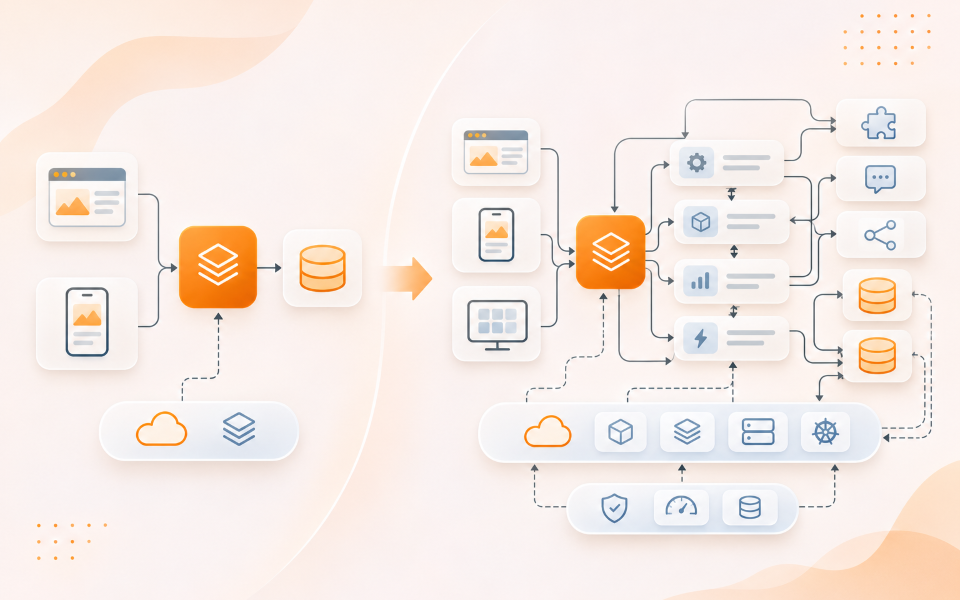
Software Architecture Consulting: When Your Product Has Outgrown Its Architecture
Your software worked well when it launched. Now every new feature takes longer, performance suffers and technical debt keeps growing. Discover when an architecture review can help your product scale.
Software Development
Custom Headless CMS Development: When Does It Make Sense?
Headless CMS can offer much more flexibility, but not every business needs it. Find out when a custom headless architecture is worth considering.
Web Development